
 Each year during Holy Week, I spend some time reflecting on one of my favorite books in the Old Testament: Lamentations. Lamentations is a very unique book that we don’t hear about too often. It is comprised of 5 poems of great sorrow. It is thought to have been written around 587 BC, after the Jewish Temple was destroyed. The Jews read it once a year on a great fast day where they commemorate the destruction of the Temple. We Christians traditionally read Lamentations on Holy Thursday, Good Friday, and Holy Saturday to capture the great sadness of how the sins of humanity led to the crucifixion of the Lord of glory. It is hard not to be moved by the great sorrow of the authors.
This year, I found myself particularly moved by this book given the circumstances we find ourselves in at the present moment. When the Temple of Jerusalem was destroyed, the ancient Jews found that their whole world had been turned upside down. The author states: “How lonely sits the city that was full of people! How like a widow has she become, she that was great among the nations! She that was a princess among the cities has become a vassal.” (Lam 1:1). A little farther on, it reads: “The roads to Zion mourn, for none come to the appointed feasts; all her gates are desolate, her priests groan; her maidens have been dragged away, and she herself suffers bitterly.” (1:4). Is not our own situation strikingly similar? At this most holy time of the year, we are unable to be present at our “appointed feasts” and the people of our church “suffer bitterly.” It seems like our entire way of life has been turned upside down. We are unable to receive the Eucharist, which Flannery O’Connor describes as the one aspect of reality that is not dispensable. Where is God in all of this? What can He possibly have planned?
I found myself praying with this on Holy Saturday, that day of great silence where we wait by the tomb of the Lord. As I read the Third Lamentation, I was struck by the dramatic change in mood:
I have forgotten what happiness is; so I say, “Gone is my glory, and my expectation from the Lord.” Remember my affliction and my bitterness, the wormwood and the gall! My soul continually thinks of it and is bowed down within me. But this I call to mind, and therefore I have hope: The steadfast love of the Lord never ceases, his mercies never come to an end; they are new every morning; great is thy faithfulness. “The Lord is my portion,” says my soul, “therefore I will hope in him.” The Lord is good to those who wait for him, to the soul that seeks him. It is good that one should wait quietly for the salvation of the Lord. It is good for a man that he bear the yoke in his youth. Let him sit alone in silence when he has laid it on him; let him put his mouth in the dust—there may yet be hope; let him give his cheek to the smiter, and be filled with insults. For the Lord will not cast off for ever, but, though he cause grief, he will have compassion according to the abundance of his steadfast love; for he does not willingly afflict or grieve the sons of men. (3:17-33)
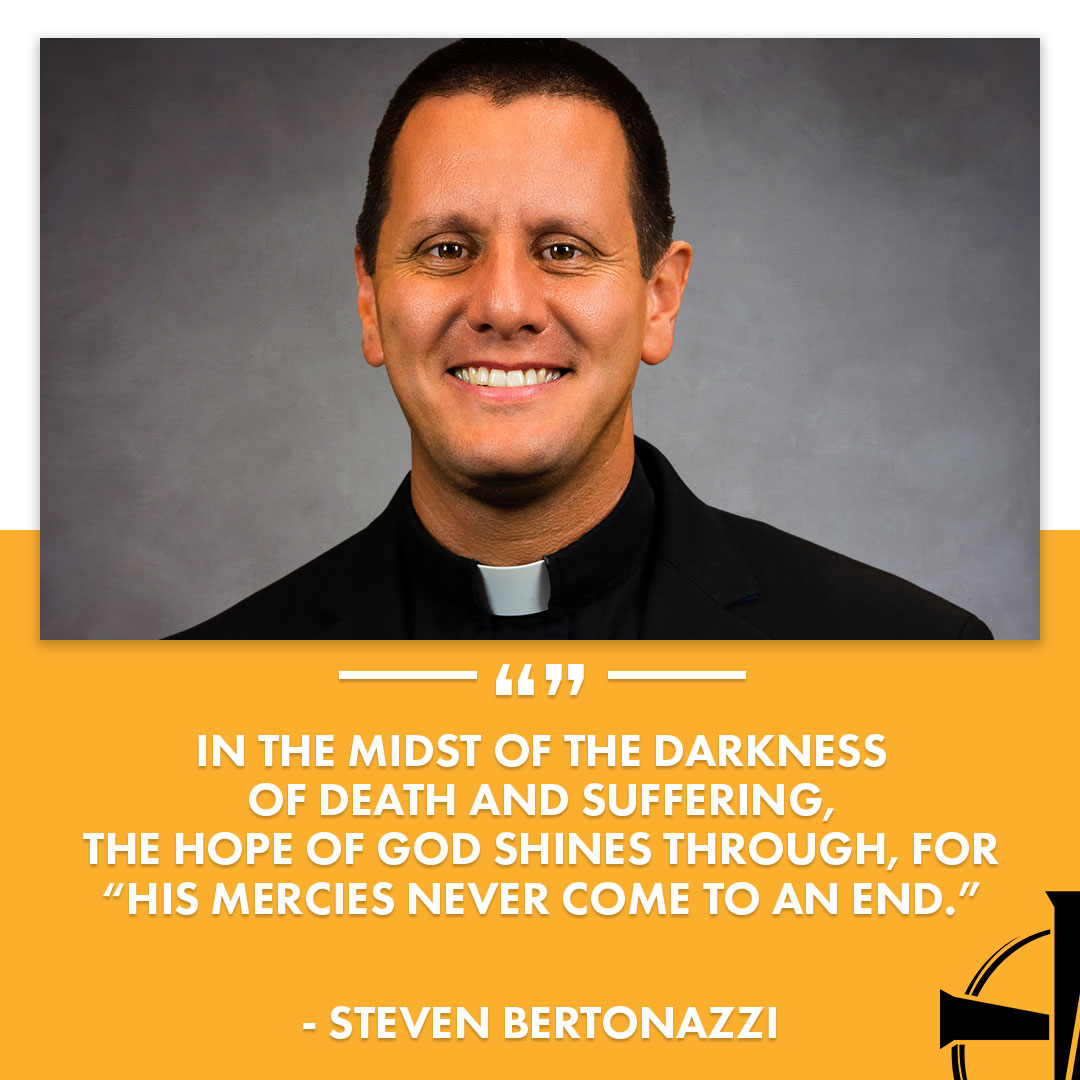
In the midst of the darkness of death and suffering, the hope of God shines through, for “his mercies never come to an end.” We now celebrate how Jesus did not hesitate to enter into the darkest portions of sinful humanity and give Himself up to be crucified for our sake. And He rose! He has won the victory! No matter how dire the suffering, our Lord stands before us as the Risen One, showing that good can come from the worst of circumstances.
One of the roles of the priestly vocation is to “bear the yoke” of the people of God: all of their sufferings and anxieties, and “to sit in silence when he has laid it on him,” presenting the needs of the people before the Lord in prayer and humble service. During these days of trial, please know that we are praying for you all! We love you! In these dark days, may the light of our Risen Lord be our guide!

Father Steven Bertonazzi
Latest posts by Father Steven Bertonazzi (see all)
- Full Swing - October 20, 2020
- Lamentations - April 23, 2020
- The Gift of Advent - December 18, 2019
